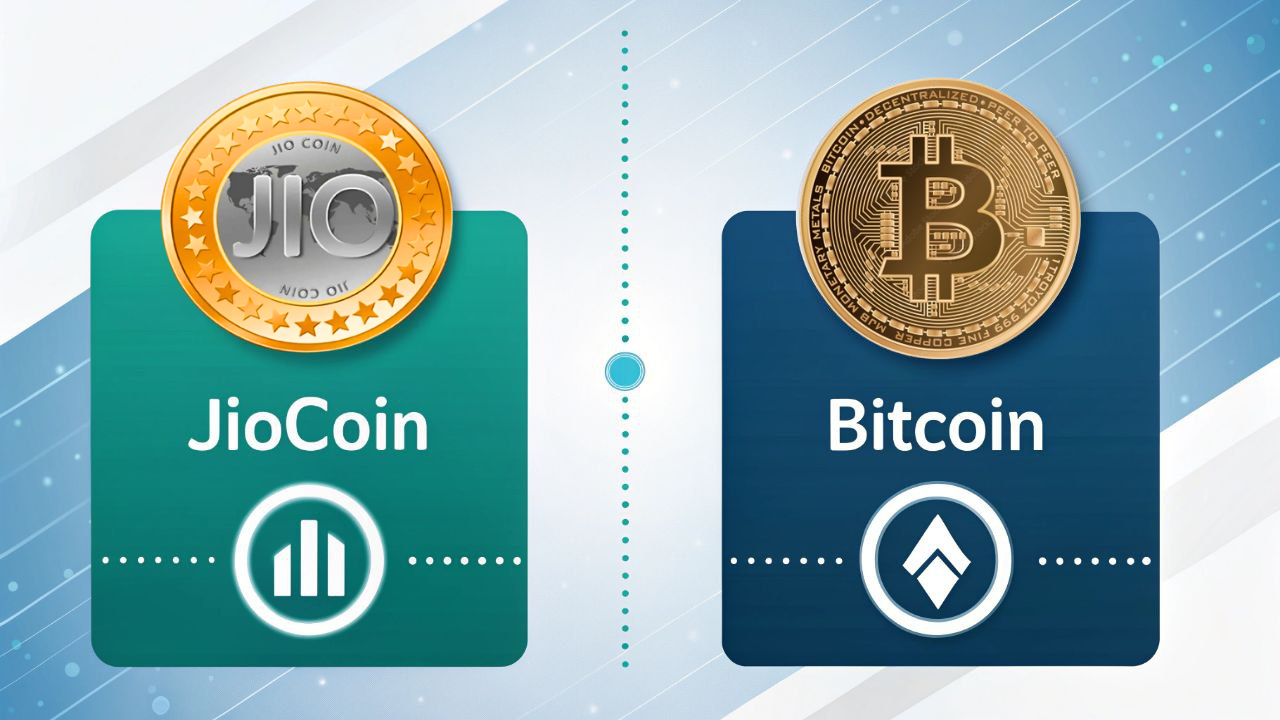
In the rapidly evolving world of digital finance, cryptocurrencies have emerged as both innovative payment solutions and attractive investment assets. Two digital tokens that often capture the spotlight are Bitcoin (BTC), the pioneering cryptocurrency commonly known as “digital gold,” and JioCoin, the native token of Reliance Jio developed in collaboration with Polygon Labs. While Bitcoin has long been considered a store of value and an investment hedge, JioCoin is carving a niche within India’s fast-growing cashless ecosystem by powering everyday transactions across platforms like JioPay, JioMart, JioCinema, and JioSaavn.
This comprehensive guide offers an in-depth comparison of JioCoin and Bitcoin, aimed at helping both new and seasoned investors understand the key differences, benefits, and risks associated with each. We’ll examine their technological foundations, use cases, market adoption, security aspects, and long-term growth potential. In addition, practical trading tips, risk management strategies, and insights into each asset’s role within a diversified portfolio will be discussed.
Overview of Bitcoin and Jio Coin
Bitcoin (BTC):
Launched in 2009 by the pseudonymous Satoshi Nakamoto, Bitcoin is the first cryptocurrency and remains the benchmark of the digital asset space. Bitcoin operates on a decentralized, Proof-of-Work (PoW) blockchain, where miners solve complex mathematical problems to validate transactions. Known for its limited supply of 21 million coins, Bitcoin’s scarcity and widespread global adoption have helped it earn the reputation of “digital gold.” Its primary use cases include serving as a store of value, a hedge against inflation, and an investment asset.
Jio Coin:
Introduced more recently, JioCoin is the native token of Reliance Jio and is built using Polygon’s Layer 2 blockchain technology. Initially designed as a reward mechanism on the JioSphere Browser, JioCoin has expanded its role to facilitate low-cost, fast digital transactions across the Reliance Jio ecosystem. Its integration into various services—from mobile recharges via JioPay to ecommerce on JioMart and entertainment on JioCinema—positions it as a utility token with substantial real-world usage in India.
Key Differences at a Glance:
| Aspect | Bitcoin (BTC) | JioCoin |
|---|---|---|
| Launch Year | 2009 | Recently introduced |
| Blockchain | Decentralized PoW blockchain | Built on Polygon’s Layer 2 |
| Primary Use Case | Store of value, investment, and digital gold | Digital payments, rewards, and everyday transactions |
| Adoption | Global, with strong institutional and retail backing | Primarily within the Indian digital ecosystem |
| Supply Characteristics | Capped at 21 million coins | Specific supply and issuance models aligned with platform growth |
| Security Model | Robust, decentralized network with high energy consumption | Secure, scalable, and cost-effective due to Layer 2 technology |
Technological Foundations
Bitcoin:
- Decentralized and Secure: Bitcoin’s PoW consensus mechanism is renowned for its robust security and decentralization. Each transaction is recorded on a public ledger, ensuring transparency and resistance to tampering.
- Scalability Issues: While Bitcoin’s network is highly secure, its transaction throughput is limited, often leading to slower processing times during high-demand periods. Initiatives like the Lightning Network aim to improve scalability, but these solutions remain in the adoption phase.
- Energy Consumption: Bitcoin mining is energy-intensive due to its PoW algorithm, which has attracted criticism regarding its environmental impact.
JioCoin:
- Efficient and Scalable: JioCoin benefits from Polygon’s Layer 2 technology, which offers high throughput, lower transaction fees, and faster processing times. This makes JioCoin well-suited for handling the high volume of transactions typical in everyday applications.
- Cost-Effectiveness: The lower fees associated with Layer 2 solutions allow JioCoin to facilitate micro-transactions and regular payments without significant cost overhead.
- Security and Control: Although JioCoin operates within a more centralized ecosystem compared to Bitcoin, it employs advanced security measures such as encryption, two-factor authentication (2FA), and biometric verification to protect user transactions.
Use Cases and Ecosystem Integration
Bitcoin Use Cases:
- Store of Value: Bitcoin is primarily regarded as a digital asset for preserving wealth over time. Its limited supply and global acceptance support its use as “digital gold.”
- Investment Vehicle: Many investors include Bitcoin in their portfolios as a hedge against inflation and currency devaluation. It’s commonly used for trading and long-term investment.
- Global Transactions: Despite occasional scalability issues, Bitcoin remains a preferred choice for cross-border transactions and international remittances due to its widespread acceptance.
Jio Coin Use Cases:
- Everyday Transactions: Integrated into Reliance Jio’s digital ecosystem, JioCoin facilitates mobile recharges, utility payments, online shopping, and digital subscriptions—making it highly practical for daily use.
- Rewards and Incentives: JioCoin is designed to reward user engagement. Users earn tokens through activities like browsing on the JioSphere Browser, paying bills via JioPay, and shopping on JioMart, which can then be redeemed for various benefits.
- Ecosystem Synergy: The seamless integration of JioCoin into multiple Reliance Jio services ensures that the token is continually used in a variety of contexts, enhancing its value and stability.
Market Adoption and Liquidity
Bitcoin:
- Global Adoption: Bitcoin enjoys widespread acceptance across numerous exchanges and financial institutions worldwide. Its liquidity is very high, meaning that traders can execute large orders with minimal impact on its price.
- Institutional Involvement: Many institutional investors have begun to include Bitcoin in their portfolios, adding to its legitimacy and supporting its price through increased demand.
Jio Coin:
- Local Ecosystem: JioCoin’s adoption is primarily driven by Reliance Jio’s vast network in India. As more users engage with the Jio ecosystem, the liquidity of JioCoin is likely to improve.
- Potential for Growth: With India’s push toward a cashless economy, JioCoin is well positioned to experience significant growth. However, its adoption is still in the early stages compared to Bitcoin’s global reach, which may lead to higher short-term volatility.
Investment Perspectives: Risk, Returns, and Portfolio Diversification
Risk and Volatility:
- Bitcoin:
Bitcoin’s volatility is well-documented. While its long-term track record has been impressive, short-term price swings can be dramatic. Diversification and risk management strategies such as stop-loss orders can help mitigate these risks. - JioCoin:
As a relatively newer asset within a developing ecosystem, JioCoin may experience higher volatility and risk. However, its potential for high growth within the local digital economy can offer substantial returns if it gains widespread adoption.
Portfolio Diversification:
- Balanced Approach:
A diversified portfolio might include a combination of Bitcoin, JioCoin, and other promising digital assets. For instance, allocating a portion of your portfolio to Bitcoin provides stability, while a smaller percentage in JioCoin capitalizes on growth potential. - Long-Term Holding (HODL) vs. Active Trading:
Beginners may benefit more from a long-term holding strategy (HODL) for both Bitcoin and JioCoin, as this approach minimizes the need for constant market monitoring and emotional trading decisions.
Investment Considerations
| Asset | Key Strengths | Potential Risks | Ideal Investment Strategy |
|---|---|---|---|
| Bitcoin (BTC) | Global recognition, high liquidity, and institutional backing. | High volatility, slower transaction speeds during peak times. | Long-term holding and cautious active trading. |
| JioCoin | Integrated within Reliance Jio ecosystem, low transaction fees, rewards mechanism. | Early-stage adoption, localized market exposure, higher short-term volatility. | Diversification as a high-growth asset, long-term positioning. |
Frequently Asked Questions (FAQs)
Answer: Bitcoin is a globally recognized digital currency primarily used as a store of value and investment asset, while JioCoin is integrated within the Reliance Jio ecosystem and is designed for everyday transactions and rewards in India.
Answer: Both can be suitable, but they serve different purposes. Bitcoin offers stability and global adoption, making it a strong long-term store of value. JioCoin has high growth potential within the Indian market, especially as digital payments become more prevalent.
Answer: Bitcoin operates on a decentralized Proof-of-Work blockchain, which, although highly secure, has scalability and energy consumption challenges. JioCoin, built on Polygon’s Layer 2 technology, offers faster processing and lower fees, making it ideal for everyday transactions.
Answer: Consider factors such as market demand, supply constraints, ecosystem integration, technological advancements, security, liquidity, and regulatory environment. Diversification and risk management strategies are also important.
Answer: Absolutely. Including both Bitcoin and JioCoin in your portfolio allows you to balance the global stability and recognized value of Bitcoin with the high-growth potential of JioCoin in the Indian market.